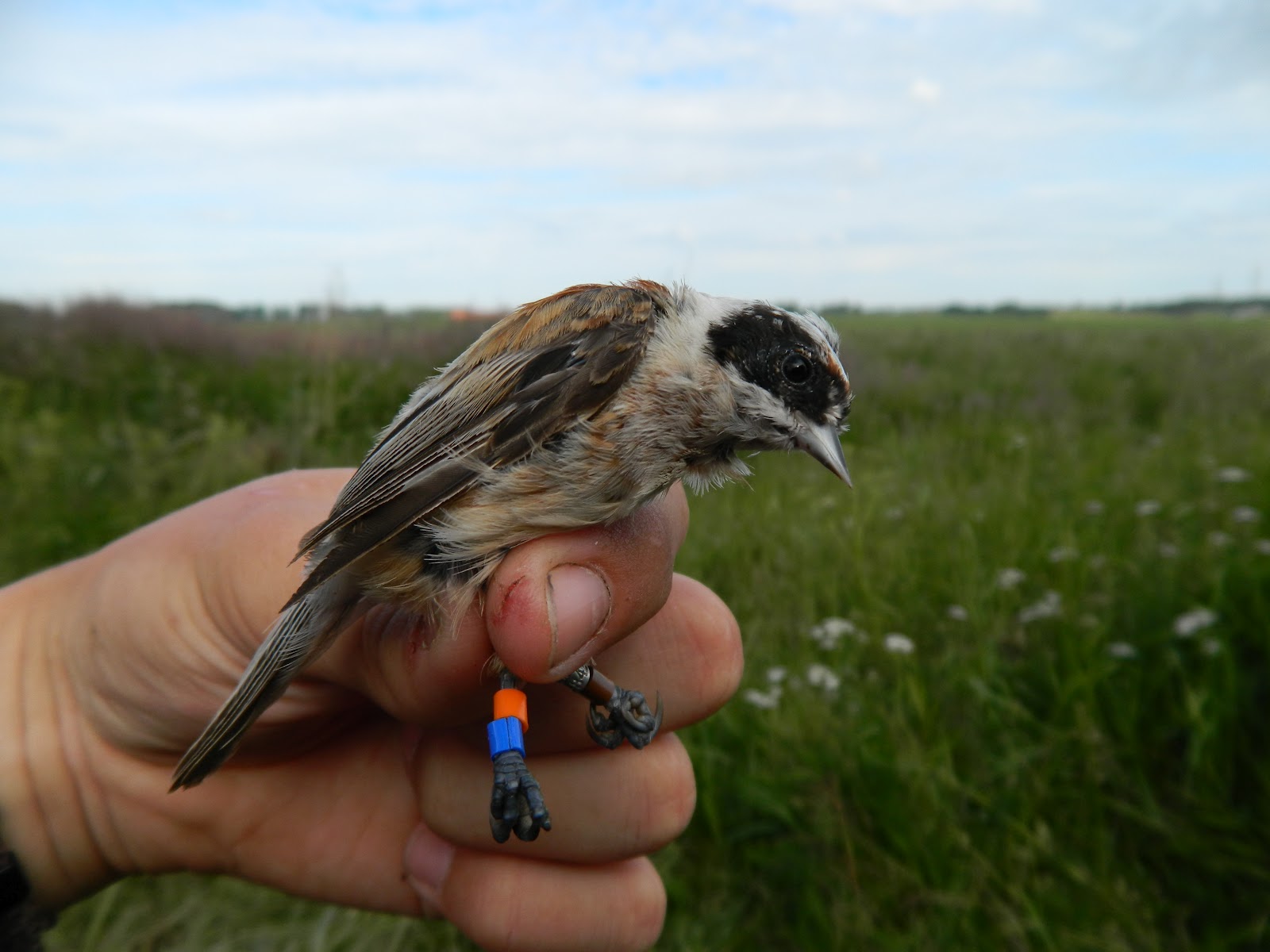
Showing posts with label Kvismare Bird Observatory. Show all posts

Friday, 27 June 2014

Listen to the Sedgies

For a long time I've wanted to post about this, and now with a little time, I hope I can enthuse you all to really listen to songs and decipher what's really going on...


Sedge Warbler - Acrocephalus schoenobaenus

Sedge warbler are a pretty common bird in Northern Europe, often heard and seldom seen well these beautiful sub-Saharan migrants certainly have a song which packs a punch, but what makes their songs so interesting?

Whilst working at Kvismaren bird observatory in Sweden, I paid great attention to the sounds of all birds around me, I'm a firm believer that time in the field and first hand experience of sights and songs is the only real way to learn something, tapes and books can only get you so far, field craft and patience fill the gaps. Back to it then, often hearing more sounds than I could identify I put a great deal of time into splitting songs up, listening to different intros, tones, flow of songs the speed etc. I found this satisfying and was able to learn a great deal. One particular part of our work in the Spring was to paddle down the Kvismare canal recording all singing Acrocephalus and Locustella warblers, typically on the reserve you can record Reed, Great Reed, Sedge, Marsh, Grasshopper, Savi's and River Warbler. Paddling along the canal on these surveys I came to notice something that I have read about with Sedge warblers; they are very good at imitation. Not only this, but I realised that as we passed through differing habitats alongside the canal, the repertoires changed. As we passed through dense reed-bed, the sedgies sang their disjointed cacophony of reed dwelling species, bearded tit, reed warbler, chiffchaff, even coot were imitated by the sedgies, all mixed in to make an almost flowing song. As we approached the marshes the sedgies would imitate greenshank, spotted redshank, spotted crake and wagtails. As we passed the bridge where swallows nested this theme continued, and the sedge warblers often incorporated swallow calls and even song into their own song. It became apparent that these birds were listening to those around them and gaining knowledge of their songs.

A term often used by sound recordists is platification of song, this refers to the learning period in a birds life when the bird is still perfecting it's song, often practice singing half heartedly to master the difficult notes or clean up the song. This plastification period is normally undertaken up until the first breeding season. The males hoping to sing a great song and show their prowess in a competitive environment when males sing full, loud songs to show their strength and condition, often the best delivered song winning the females and gaining the chance to breed.

With sedgies then, the plastification period may be longer than your average bird, learning to imitate birds wherever they come into contact with them and learning the calls well. This in theory increases repertoires and becomes a fuller (more impressive song). I have come to write this blog after listening to a sedgie on my local patch. Marton mere in Blackpool is your average reed bed nature reserve, certainly nothing super special, no breeding bitterns or locked gates, no wardens overseeing a strict management plan, no buffer zones or properly restricted access, just your regular slightly out of town reserve. Whilst listening to this sedgie half-heartedly I began to hear some strange calls. Whimbrel and Spotted crake were heard as clear as day. Those seven whistles had me scanning the skies and the dripping tap had me thinking the early morning had got to me, then I realised, sedgie!

Although disappointed at the lack of scarcity for the patch, this provided more questions than answers, where had this sedgie learnt these calls and why was it bringing them up into song now if those species imitated are nowhere to be seen (or heard). It makes me wonder two things, firstly has this sedgie heard these birds elsewhere on migration and remembered them (to add them into a song later in life) - Increased repertoire = increased breeding success? or has this sedgie heard these birds hear, on the mere and decided to imitate them off the top of his head? either way it seems beneficial for him to sing others songs, otherwise, why would he bother?

Does this mean then that if you hear sedgies singing other species' songs that they have been in direct contact with that species, the answer is probably. I've not heard of any studies on heritability of song within sedge warblers and I can only imagine that due to their prolonged plastification period (if in fact it ever ends) they only inherit their typical chundering  song as an innate trait and then build their own song through experience and learning off their neighbours.

I wanted to include a whole host of sedge warbler songs that I had recorded myself into this post, but unfortunately I only have one http://www.xeno-canto.org/178218 (you'll need headphones for it I suspect). In this recording you should be able to decipher at least 3 distinct imitations; Yellow wag, Whitethroat and Swallow - interestingly all these species were present in the immediate area of where this recording was taken in Nottinghamshire.

So, my advice, rather than spend hours inside this summer moaning about how little can be seen at this time of year (unless you're cleaning up on passage waders or raptors), go out and listen to your local sedgies, try to pick apart their songs and see if there is anything interesting within the repertoires.

Personally I've heard sedgies imitate over 20 species. From Grey Heron, through Greenshanks and Bearded Tit to Spotted crake and Thrush Nightingale. They truly are immense at imitation and the more recordings gained from them, the more we will learn. Just leave your mobile voice recording and wander off, you may be surprised at the results.

Thanks for sticking with this, if you got this far. As always, apologies for the lack of postings.

Monday, 31 December 2012

A fantastic year.

 
As 2012 comes to a close, I look back on what has been an absolutely mega year for me; birding and bird ringing. I began to keep more detailed field notes and have recorded new behaviours in birds. Seen and ringed new birds including a couple of great "self finds" - Lesser Spotted Eagle in Sweden being the highlight.

A seven month trip to Scandinavia was awesome and along with a few friends we ringed over 11'000 birds of more than 110 Species and processed many more. Whilst back in the UK the weather hasn't been great but still we've managed to get a few birds ringed. The official Fylde Ringing group totals aren't about as yet and I can only take minimal credit for my input to the totals. However the effort by  Ian and Phil in particular has been great and between them they ring on an almost daily basis.

We have started a new project leg flagging Turnstones at a winter feeding station and so far around 30 birds have been marked, though we expect this number to double or maybe treble by the spring migration period. These Turnstones are marked with a green colour ring below the knee on the right leg (Tibia) and a Black flag with White encryption of the left leg; above knee (Tarsus). Any sightings of these birds would be greatly appreciated and a full history of sightings/re-sightings will be sent back in return for any information. If you happen to see any flagged Turnstones please inform us Via nwturnstones"@"gmail.com

Leg Flagged (Ruddy) Turnstone - Arenaria interpres Photo: Ian Gardener.

We have also joined forces with Kev and Sean on the Isle of man and hope we catch catch and colour ring a few more large Gulls as the winter draws on! These birds will be fitted with Black colour rings with Yellow encryption. Any sightings of these birds would be greatly appreciated too and as before a full history will be supplied on submission of a sighting.

It's been a pretty hectic year really. Some fantastic birds caught, some amazing places visited and spending it all with some amazing friends to make some great memories! 2012 has been a tremendous year and hopefully 2013 will be another great one; though with no continental visits planned and probably another wet summer in the UK our work is most definitely, cut out!

Below are the combined totals of Kvismaren (Sweden) and Gedser (Denmark)
Kvismaren totals represent all the birds ringed where as Denmark is just personal totals.

Kvismaren / Gedser

Greylag Goose    1 / 0
Barnacle Goose   0 / 1
Teal                       2 / 0
Sparrowhawk      1 / 39
Kestrel                  8 / 1
L Ringed Plover  1 / 0
Ringed Plover      4 / 0
Lapwing               8 / 0
Knot                      1 / 0
Curlew Sand        1 / 0
Dunlin                  3 / 0
Ruff                      4 / 0
Snipe                     5 / 0
Wood Sand          20 / 0
Common Sand     6 / 0
Woodcock             0 / 1
Black-head Gull   35 / 0
Herring Gull         1 / 0
Common Tern       13 / 0
Black Tern             10 / 0
Wood Pigeon          1 / 0
Long-eared Owl      3 /2
Tengmalm's Owl     0 / 6
Swift                         1 / 0
Great Spotted Woodpecker  2 / 0
Lesser Spotted Woodpecker   4 / 0
Sand Martin             57 / 0
Swallow                    912 / 0
House Martin             2 / 0
Tree Pipit                  61 / 0
Yellow Wag                 6 / 0
Grey Wag                    1 / 0
White Wag                78 / 0
Waxwing                     0 / 14
Wren                           27 / 113
Dunnock                     14 / 104
Robin                         250 / 318
Thrush Nightingale      56 / 0
Bluethroat                      2 / 0
Black Redstart              0 / 1
Redstart                         5 / 11
Whinchat                      7 / 0
Wheatear                      4 / 0
Ring Ouzel                    0 / 1
Blackbird                     36 / 52
Fieldfare                       23 / 7
Song Thrush                18 / 68
Redwing                         3 / 21
Grasshopper Warbler   4 / 0
River Warbler                2 / 0
Savi's Warbler               1 / 0
Sedge Warbler             259 / 0
Marsh Warbler            19 / 0
Reed Warbler              818 / 1
Great Reed Warbler   149 / 0
Icterine Warbler            7 / 0
Barred Warbler             1 / 0
Lesser Whitethroat      12 / 0
Whitethroat                  36 / 1
Garden Warbler         106 / 0
Blackcap                     104 / 19
Wood Warbler               2 / 0
Chiffchaff                    15 / 206
Willow Warbler         607 / 1
Goldcrest                    322 / 463
Firecrest                          0 / 2
Spot Fly                         29 / 0
Pied Fly                        119 / 0
Bearded Tit                   52 / 0
Long-Tailed Tit             25 / 12
Coal Tit                          95 / 13
Blue Tit                       590 / 1342
Great Tit                    362 / 166
Nuthatch                     30 / 0
Treecreeper                  8 / 0
Penduline Tit              17 / 0
Red-backed Shrike      5 / 0
Great-grey Shrike        0 / 1
Magpie                          4 / 0
Jay                                 0 / 4
Jackdaw                        1 / 0
Starling                     269 / 0
Tree Sparrow            60 / 12
Chaffinch                135 / 83
Brambling                22 /10
Greenfinch               41 / 7
Goldfinch                  4 / 4
Siskin                       20 / 8
Redpoll                      0 / 4
Linnet                        1 / 0
Bullfinch                   0 / 12
Rosefinch                  1 / 0
Yellowhammer        25 / 0
Ortolan Bunting      11 / 0
Reed Bunting        281 / 16

 Totals                  6397 / 3147


The UK totals will shortly be available on Seumus' Blog no doubt. Though as previously stated the guys in the ringing group must take the lion share of the credit, their perseverance through the atrocious weather has most certainly paid off.   

Below are some of the highlights of 2012 for me!

Long-eared Owls adults. (Male left, Female right)

Black Tern, Fledgling

Black Redstart 1cy

Curlew Sandpiper 2cy +

Mug shot and Barnacle Goose

Ortolan Bunting 1cy (photo Zac Hinchcliffe)

Pink-footed Goose 2cy+

Sparrowhawk 1cy Male

Tengmalm's Owl


Thanks to you all for reading throughout 2012 and I hope you all have a fantastic, bird filled 2013. All the best.

Wednesday, 10 October 2012

Mad months

Apologies for not posting since July end. To be honest the last 2 and a half months have been mental. Here I'll summarize Kvismaren (with totals and a few pics) and try to bring you up to date with mine and the girlfriends new adventures in Denmark at Gedser Bird observatory.

So, we left Kvismaren and closed down the station on October 1st after I had spent 5 and a half months living there this year and the same the year before. We finished our ringing efforts on the 30th September after around 90 days of ringing (subtracting the raining offs). Totals below.

Greylag Goose 1
Teal 2
Sparrowhawk 1
Kestrel 8
Little Ringed Plover 1
Ringed Plover 4
Lapwing 8
Knot 1
Curlew Sandpiper 1
Dunlin 3
Ruff 4
Snipe 5
Wood Sandpiper 20
Common Sandpiper 6
Black-headed Gull 35
Herring Gull 1
Common Tern 13
Black Tern 10
Wood Pigeon 1
Long-Eared Owl 3
Swift 1
Great Spotted Woodpecker 2
Lesser Spotted Woodpecker 4
Sand Martin 57
Swallow 912
House Martin2
Tree Pipit 61
Yellow Wagtail 6
Grey Wagtail 1
White Wagtail 78
Wren 27
Dunnock 14
Robin 250
Thrush Nightingale 56
Blue Throat 2
Redstart 5
Whinchat 7
Wheatear 4
Blackbird 36
Fieldfare 23
Song Thrush 18
Redwing 3
Grasshopper Warbler 4
River Warbler 2
Savi's Warbler 1
Sedge Warbler 259
Marsh Warbler 19
Reed Warbler 818
Great Reed Warbler 149
Icterine Warbler 7
Barred Warbler 1
Lesser Whitethroat 12
Whitethroat 36
Garden Warbler 104
Blackcap 101
Wood Warbler 2
Chiffchaff 15
Willow Warbler 607
Goldcrest 322
Spotted Flycatcher 29
Pied Flycatcher 119
Bearded Tit 52
Long-tailed Tit 25
Marsh Tit 33
Willow Tit 1
Coal Tit 95
Blue Tit 590
Great Tit 362
Nuthatch 30
Treecreeper 8
Penduline Tit 17
Red-backed Shrike 5
Magpie 4
Jackdaw 1
Starling 269
Tree Sparrow 60
Chaffinch 135
Brambling 22
Greenfinch 41
Goldfinch 4
Siskin 20
Linnet 1
Rosefinch 1
Yellowhammer 25
Ortolan Bunting 11
Reed Bunting 281

Total Ringed 6397

Below are some pics from Kvismaren.

Brambling 1cy Female

Lesser Spotted Woodpecker 2cy+ female

Little Ringed Plover 1cy

Redstart 1cy female

Spotted Flycatcher 1cy

Wood Warbler (Left), Willow Warbler (Right)

Wood Warbler 1cy, stunner
Now I'm sat in Denmark, watching the rain hit the window. Another post about our lives in Gedser will appear shortly!

Tuesday, 31 July 2012

Kvismare Totals

It's been a good while since I last blogged, so I'll bring you up to date with totals from the ringing season so far. Ending July we're in about the same place numbers wise as last year but there're some interesting differences. Robins and most warblers are slightly down on last year but Tits, Finches and Buntings have fared well.

Greylag Goose - 1
Sparrowhawk - 1
Kestrel - 8
Ringed Plover - 4
Lapwing - 8
Knot - 1
Curlew Sandpiper - 1
Dunlin - 3
Ruff - 1
Snipe - 5
Wood Sandpiper - 11
Common Sandpiper - 5
Black-headed Gull - 34
Herring Gull - 1
Common Tern - 13
Black Tern - 10
Wood Pigeon - 1
Long-eared Owl - 3
Swift - 1
Lesser Spotted Woodpecker - 1
Sand Martin - 55
Swallow - 27
House Martin - 1
Tree Pipit - 4
Yellow Wagtail - 4
White Wagtail - 23
Wren - 1
Robin - 23
Thrush Nightingale - 48
Redstart - 1
Whinchat -7
Wheatear - 4
Blackbird - 17
Fieldfare - 21
Song Thrush - 5
Redwing - 1
Grasshopper Warbler - 3
River Warbler - 2
Savi's Warbler - 1
Sedge Warbler - 99
Marsh Warbler - 3
Reed Warbler - 257
Great Reed Warbler - 134
Icterine Warbler - 6
Lesser Whitethroat - 2
Whitethroat - 16
Garden Warbler - 51
Blackcap - 50
Chiffchaff - 1
Willow Warbler - 199
Spotted Flycatcher - 12
Pied Flycatcher - 112
Bearded Tit - 37
Marsh Tit - 25
Blue Tit - 265
Great Tit - 224
Nuthatch - 20
Penduline Tit - 17
Red-backed Shrike - 1
Magpie - 4
Jackdaw - 1
Starling - 269
Tree Sparrow - 58
Chaffinch - 43
Greenfinch - 30
Goldfinch - 4
Linnet - 1
Rosefinch - 1
Yellowhammer - 16
Ortolan Bunting - 10
Reed Bunting - 158

Total - 2487

71 Species


Three recent highlights...

Curlew Sandpiper (Calidris ferruginea) 2cy+

"Red" Knot (Calidris canutus) 2cy

Ruff (Philomachus pugnax) 1cy female
Controls come in the form of a French Penduline Tit, a Swedish Penduline Tit, a Croatian Sedge Warbler, a Belgium Reed Warbler and a Slovenian Great Reed Warbler.

Sunday, 8 July 2012

The ringing season part 1

The ringing season in Kvismare has been standardised since the early 1990's with 2 sites and 20 and 24 nets in each. The largest site (Vallen) has 24 * 9metre nets in a mixture of small scrub land and wet reed bed. The other site (Banvallen) is a line of bushes bordering an old railway line and now running alongside a wet reed area.

The ringing season starts on, or around the Midsummer area in Sweden; this year we began on 24th June. The season runs until the end of September. Nets are to be up by dawn and down 6 hours after unless the catching is good in which case the ringers' can stay on, ringing until the catching slows.

Between 24th June and 8th July we have ringed on all but 2 mornings and this was due to heavy rain/wind. We have caught around 900 birds of many species. Ad-hoc ringing has also taken place and this added a few more nice species to our lists.

The Highlights so far are shown below. 

Red-backed Shrike - Lanius collurio (male)

Bearded Tit - Panurus biarmicus 1cy male (left) and 1cy female (right)

Penduline tit - Remiz pendulinus. Female (2nd from right) and young.


Snipe - Gallinago gallinago 2cy+

Penduline Tit - Remiz pendulinus. Adult male, originally ringed in France.

Black tern - Chlidonias niger. 1st Calendar year

Great Reed warbler - Acrocephalus arundinaceus. 2cy with data logger

Black tern - Chlidonias niger. 7 of 10 1cy birds caught

Wheatear - Oenanthe oenanthe. 1st Calendar year

Kestrel - Falco tinnunculus. 1 of 7 chicks ringed.

Saturday, 16 June 2012

Swift update.

We're still quite busy with all things survey at the moment as all the spring work comes into it's crucial final stages. Ortolan Buntings are feeding youngsters, which is great news, we ringed a brood of 4 chicks last week and they luckily fledged hours before the farmer cut his grass. I was horrified to wake up to see the farmer had mown in the night. See below the open-topped nest remains. 
 
Ortolan Bunting after mowing, a sorry scene.


The Marsh harriers we have monitored through spring have hatched and look amazingly cute. There is a runt, but I'm sure they'll find enough food to equal things out as the adults are hunting non-stop throughout the day.
Marsh Harrier Circus aeruginosus. Photo; Strahil Peev

Heather has arrived and now work begins to start preparing the nets and net rides ahead of the ringing season; yesterday whilst fixing nets this little gem landed next to me. I was very, very surprised because I've always been told you need to flick-net for Swifts, maybe this one was a stupid individual. Though it was a stunning stupid individual and a very welcome ringing tick. I now know why Seumus told me his fingers were like pin cushions after handling many of them.


Swift - Apus apus
We also finished off the first round of "normal" nest boxes with a brood of Pied flycatcher. Heather also got to grips with a bit of mist netting and caught this known age Tree Sparrow. Ringed here 1 year ago (almost to the day) as a chick. He can now be sexed on his cloacal protuberance.

Heather and Mr Tree Sparrow - Passer montanus
Pied Flycatcher chicks - Ficedula hypoleuca
A few days ago we heard Long-eared Owl chicks near the house and after a short search I found the nest and climbed to it. The result, 3 Long-eared Owlets ringed. 
Long-eared Owl chicks - Asio otus
One of the chicks 8 days on.

Long-eared Owlet in nest - Asio otus

Wednesday, 6 June 2012

Worth a post.

First of all apologies for not posting in nearly 3 weeks. I was busy winning the bird race against Magnus. The final scores Craig 141 - Magnus 134. A combined total of 148 Species were seen during the "race" which took place between 9th and 31st May, the prize this year is only beer as after Magnus' dip in the Canal last year Anthrax was discovered on the banks exactly where he went in... He was therefore a bit worried last year and now won't jump back in! It was a nice competition this year anyway and we each saw "lifers". I had Broad-billed Sandpiper, Golden Oriole (bad but true) and Blue-winged Teal, Magnus had the latter and Glossy Ibis for his "lifers".

Other than the competition we've been busy surveying things all over the reserve. A project on Sedge Warblers is hotting up and the Ortolan's are getting down to their breeding business (a pair carrying food today was nice). I was supposed to be studying Savi's warblers but Kvismaren is reflecting the national trend this year and NONE have arrived. I'll keep listening for them though. Marsh Harriers are down on eggs now and all of our farmland surveys are completed. Highlights from there included finding 4 Dotterel which filled the scope on minimum zoom, stunning birds!!!

I've finished with the Starlings after ringing nearly 260 shitted up stinking chicks. I think I've ringed enough for a lifetime now?


Also we've ringed a lot of Blue and Great tit chicks with more to check up on soon. All of the Pied flycatchers are still on eggs but I've managed to lift and ring at least 5 females.

As part of the Ortolan project we were asked to try to catch a bird to take a feather sample for analysis, so late last night/early this morning I decided I would stay up all night and attempt to catch an unpaired male at dawn! I headed out a 3 am with mist net and playback lures and set a net near our unpaired guy, I narrowly avoided catching both a Fox and a Wild Boar the latter of which was running at full speed towards the net and grunting furiously. The conditions were against me and the bird not singing back to the song I was a little worried we were too late and he'd moved off? Less than 10 minutes after I'd set the net and started the playback, I saw what appeared to be a Bunting flitting around in a nearby bush... next thing, I looked and it was in! A stunning 2cy male Ortolan Bunting, definitely worth no sleep and a gorgeously gripping ringing tick!!! Below are a few shitty pictures of the stunning bird, the light was terrible and my excitement probably a bit too much to make any decent pics, but less excuses you can see how stunning he is!

                                          Emberiza hortulana 2cy male 


Saturday, 5 May 2012

The Ortolan's return

Many hours have been spent over the past weeks have been spent listening for Ortolan bunting's in suitable habitats around Kvismare. After a preliminary study last year found Ortolan's to still be breeding here. Only around 100 territories still exist in this area of in south-central Sweden, spanning much of Närke and Västmanland. The Ortolan's have declined massively in the past 2 decades and the population in Närke is now a fraction of it's former self. The Ortolan population in northern Sweden however is esitmated to be around 6000 pairs.


Ortolan Bunting (Emberiza hortulana)

 With the Ortolan population decreasing so rapidly across much of northern Europe action is being taken in many areas. Here at Kvismare, we aim mainly to provide suitable breeding areas for the birds. The Bird Observatory and Ornithological Society of Sweden have subsidised farmers in the local area to leave parts of their land unsown next to outcrops of woodland/rocks and in strips at the edges of fields; this is not only to provide the black soils which is a niche for breeding Ortolans', but also to aid the birds feeding habits.

So out and about this week we have now found 3 Singing Ortolan males around the areas where they were seen to breed last year. So far all is looking good and the land still seems suitable. Our aim over the next few weeks is to monitor these birds and distinguish whether they can breed successfully here. We will visit nests and count and measure chicks, undertake feeding counts and study the adults behaviour if/when nesting occurs. We will also make several attempt to catch insects at various points in the survey area to understand more about the Ortolans' needs.

I will update on progress when there is any, but for now we hope for decent weather and plenty of Ortolans'.

Friday, 27 April 2012

Grim up North

With spring late to arrive here in Central Sweden it's been a slow couple of weeks bird wise. The main work at the moment comprises of wetland surveys and Starling nest box checks. The wetland surveys however are very enjoyable and there's always the hint of mystery at what might turn up? I was surveying some marshland last week and here I came across an oddity, not a big rare in terms of British or even Swedish birding but a 3cy Caspian Gull was the first record for Kvismaren and the first I've seen in a while. The Ferruginous duck is still present on the reserve looking rather smart amongst the Tufted's and many other ducks are starting to move through in good numbers now. Goldeneye, Pochard, Teal and Wigeon mainly with well over 1000 of the latter two species.
Wintry wetland survey.

With help arriving this week (Maggie from Germany) we were able to put up some large nest boxes around the reserve. These boxes are mainly for Goldeneye and Tawny Owl although lots of Starlings seemed interested whilst we were putting them up. It's too late this year for the Tawny's but the Goldeneye's are still passing through, pairing up and looking for nest sites.

Goldeneye (Bucephala clangula) Box
We've also caught a few birds this past couple of weeks, nothing mega in terms of numbers but it's nice to pass the time watching mist nets (even though they're often empty). Highlights include a cracking male Kestrel and today a Woodpigeon (not a rarity, but not often caught). A Long-eared owl has been seen around the house for the past 3 days and we've flushed it from the side of net rides more times than I care to recall! Hopefully it'll either jump into a net on it's own soon, or I'll set up the big nets and annoy it until it's caught.

Kestrel (Falco tinnunculus) 2cy Male


Thursday, 19 April 2012

Time to blog?

Since my last "update" I've not really had much time to blog.

The first week here I've just been up at dawn and counting wildfowl and waders using Kvismaren as either passage or breeding sites, it's really nice to be out at first light and I've seen some great things this week whilst being out and about. A first for me was a Lesser black-backed gull (intermedius) though I don't class this as a species I'd still never see 'one' before. Also I saw a male Ferruginous Duck (Aythya nyroca) which again I'd never seen before. I've seen a female before but it was way back through some horrible binoculars (which have been lovingly likened to "like looking through cardboard" by my ringing trainers and group). So after stunning view of both of these a male Long-tailed duck turns up and again giving great views, I've not seen these so well since a memorable trip to Iceland a couple of summers ago with Kane, Chris and Ciaran.

So enough of that. Other decent birds this week: 3 Osprey, White-tailed eagle, Green sands (here there and everywhere), Rough-legged buzzard at least 4, 2 Hen Harrier (Female and 2cy male, hunting together). 20+ Marsh Harriers, 200 Bean Geese (inc 2 Anser fabalis rossicus) 25 Pinkies, 80 White-fronts (all albifrons) , 20 Barnacles. Hundreds of Meadow pipit in a roost. 1000+ Cranes (Grus grus). Lots of Roe Deer around the house, a hare and today I almost fell over a Beaver before it slapped it's tail and with a glug disappeared out of site.

I've also started ringing in the garden.

1 Great Tit.
1 Chaffinch.
1 Robin.
1 Kestrel.

Sorry about the lack of photos with my laptop dead I'm reduced to the old fashioned office PC here at Kvismaren.

Saturday, 14 April 2012

Update - A post for Mummy.

It's been a while since I last blogged and in that time I have had various outings within the Fylde ringing and birding, most can be read about on my friend Seumus' blog "Fleetwood Birder", see link at side. I have however now left England for 8 months to work as Surveyor and Lead Bird ringer at Kvismaren Bird Observatory (until October) and later Lead bird ringer at Gedser Bird Obs in Denmark.

So I arrived in Sweden on the 12th April and already I'm getting stuck into the work! I am alone in the station at the moment but I have had a nice beginning to the season with a relaxed workload (for now) and lots of catching up with the birds and the neighbours.
At the moment the work is mainly surveys of the Wetland birds around the reserve and checking of the Starling boxes around the reserve. When other personell arrive however the workload multiplies many times over. A brief meeting with Bo (The Boss) revealed more about this years' surveys and I must say I am very excited to be involved in some hopefully ground breaking work.
For now though it's just a "I got here safely Mummy" and a few snaps from the first couple of days.
Nuthatch (Sitta europaea europaea) - Nest building outside the kitchen window.

Grass snake (Natrix natrix) mating, Female is the larger snake. 2 Males are squabbling to mate.