Wednesday, 10 October 2012

Mad months

Apologies for not posting since July end. To be honest the last 2 and a half months have been mental. Here I'll summarize Kvismaren (with totals and a few pics) and try to bring you up to date with mine and the girlfriends new adventures in Denmark at Gedser Bird observatory.

So, we left Kvismaren and closed down the station on October 1st after I had spent 5 and a half months living there this year and the same the year before. We finished our ringing efforts on the 30th September after around 90 days of ringing (subtracting the raining offs). Totals below.

Greylag Goose 1
Teal 2
Sparrowhawk 1
Kestrel 8
Little Ringed Plover 1
Ringed Plover 4
Lapwing 8
Knot 1
Curlew Sandpiper 1
Dunlin 3
Ruff 4
Snipe 5
Wood Sandpiper 20
Common Sandpiper 6
Black-headed Gull 35
Herring Gull 1
Common Tern 13
Black Tern 10
Wood Pigeon 1
Long-Eared Owl 3
Swift 1
Great Spotted Woodpecker 2
Lesser Spotted Woodpecker 4
Sand Martin 57
Swallow 912
House Martin2
Tree Pipit 61
Yellow Wagtail 6
Grey Wagtail 1
White Wagtail 78
Wren 27
Dunnock 14
Robin 250
Thrush Nightingale 56
Blue Throat 2
Redstart 5
Whinchat 7
Wheatear 4
Blackbird 36
Fieldfare 23
Song Thrush 18
Redwing 3
Grasshopper Warbler 4
River Warbler 2
Savi's Warbler 1
Sedge Warbler 259
Marsh Warbler 19
Reed Warbler 818
Great Reed Warbler 149
Icterine Warbler 7
Barred Warbler 1
Lesser Whitethroat 12
Whitethroat 36
Garden Warbler 104
Blackcap 101
Wood Warbler 2
Chiffchaff 15
Willow Warbler 607
Goldcrest 322
Spotted Flycatcher 29
Pied Flycatcher 119
Bearded Tit 52
Long-tailed Tit 25
Marsh Tit 33
Willow Tit 1
Coal Tit 95
Blue Tit 590
Great Tit 362
Nuthatch 30
Treecreeper 8
Penduline Tit 17
Red-backed Shrike 5
Magpie 4
Jackdaw 1
Starling 269
Tree Sparrow 60
Chaffinch 135
Brambling 22
Greenfinch 41
Goldfinch 4
Siskin 20
Linnet 1
Rosefinch 1
Yellowhammer 25
Ortolan Bunting 11
Reed Bunting 281

Total Ringed 6397

Below are some pics from Kvismaren.

Brambling 1cy Female

Lesser Spotted Woodpecker 2cy+ female

Little Ringed Plover 1cy

Redstart 1cy female

Spotted Flycatcher 1cy

Wood Warbler (Left), Willow Warbler (Right)

Wood Warbler 1cy, stunner
Now I'm sat in Denmark, watching the rain hit the window. Another post about our lives in Gedser will appear shortly!

Tuesday, 31 July 2012

Kvismare Totals

It's been a good while since I last blogged, so I'll bring you up to date with totals from the ringing season so far. Ending July we're in about the same place numbers wise as last year but there're some interesting differences. Robins and most warblers are slightly down on last year but Tits, Finches and Buntings have fared well.

Greylag Goose - 1
Sparrowhawk - 1
Kestrel - 8
Ringed Plover - 4
Lapwing - 8
Knot - 1
Curlew Sandpiper - 1
Dunlin - 3
Ruff - 1
Snipe - 5
Wood Sandpiper - 11
Common Sandpiper - 5
Black-headed Gull - 34
Herring Gull - 1
Common Tern - 13
Black Tern - 10
Wood Pigeon - 1
Long-eared Owl - 3
Swift - 1
Lesser Spotted Woodpecker - 1
Sand Martin - 55
Swallow - 27
House Martin - 1
Tree Pipit - 4
Yellow Wagtail - 4
White Wagtail - 23
Wren - 1
Robin - 23
Thrush Nightingale - 48
Redstart - 1
Whinchat -7
Wheatear - 4
Blackbird - 17
Fieldfare - 21
Song Thrush - 5
Redwing - 1
Grasshopper Warbler - 3
River Warbler - 2
Savi's Warbler - 1
Sedge Warbler - 99
Marsh Warbler - 3
Reed Warbler - 257
Great Reed Warbler - 134
Icterine Warbler - 6
Lesser Whitethroat - 2
Whitethroat - 16
Garden Warbler - 51
Blackcap - 50
Chiffchaff - 1
Willow Warbler - 199
Spotted Flycatcher - 12
Pied Flycatcher - 112
Bearded Tit - 37
Marsh Tit - 25
Blue Tit - 265
Great Tit - 224
Nuthatch - 20
Penduline Tit - 17
Red-backed Shrike - 1
Magpie - 4
Jackdaw - 1
Starling - 269
Tree Sparrow - 58
Chaffinch - 43
Greenfinch - 30
Goldfinch - 4
Linnet - 1
Rosefinch - 1
Yellowhammer - 16
Ortolan Bunting - 10
Reed Bunting - 158

Total - 2487

71 Species


Three recent highlights...

Curlew Sandpiper (Calidris ferruginea) 2cy+

"Red" Knot (Calidris canutus) 2cy

Ruff (Philomachus pugnax) 1cy female
Controls come in the form of a French Penduline Tit, a Swedish Penduline Tit, a Croatian Sedge Warbler, a Belgium Reed Warbler and a Slovenian Great Reed Warbler.

Sunday, 8 July 2012

The ringing season part 1

The ringing season in Kvismare has been standardised since the early 1990's with 2 sites and 20 and 24 nets in each. The largest site (Vallen) has 24 * 9metre nets in a mixture of small scrub land and wet reed bed. The other site (Banvallen) is a line of bushes bordering an old railway line and now running alongside a wet reed area.

The ringing season starts on, or around the Midsummer area in Sweden; this year we began on 24th June. The season runs until the end of September. Nets are to be up by dawn and down 6 hours after unless the catching is good in which case the ringers' can stay on, ringing until the catching slows.

Between 24th June and 8th July we have ringed on all but 2 mornings and this was due to heavy rain/wind. We have caught around 900 birds of many species. Ad-hoc ringing has also taken place and this added a few more nice species to our lists.

The Highlights so far are shown below. 

Red-backed Shrike - Lanius collurio (male)

Bearded Tit - Panurus biarmicus 1cy male (left) and 1cy female (right)

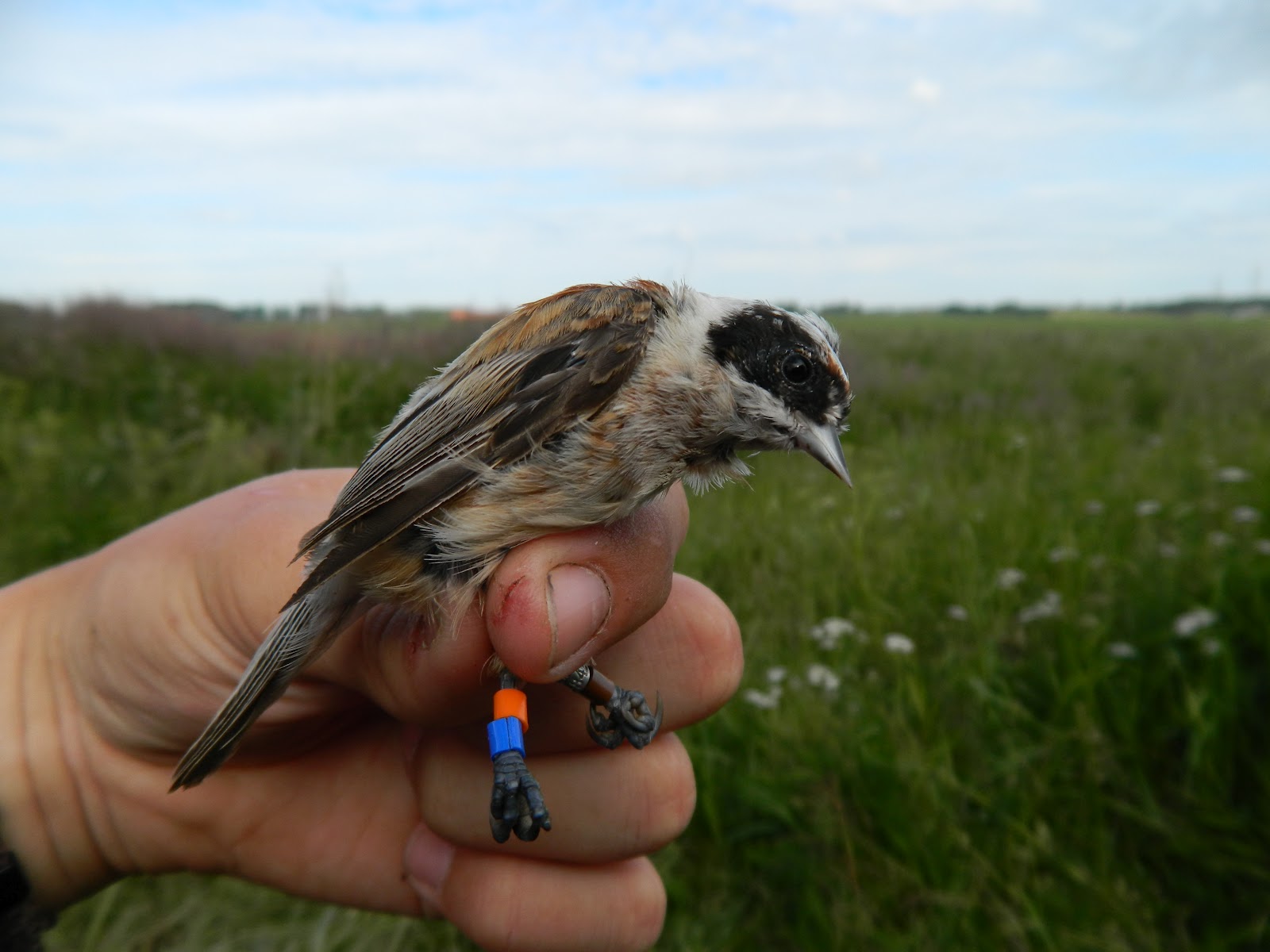
Penduline tit - Remiz pendulinus. Female (2nd from right) and young.


Snipe - Gallinago gallinago 2cy+

Penduline Tit - Remiz pendulinus. Adult male, originally ringed in France.

Black tern - Chlidonias niger. 1st Calendar year

Great Reed warbler - Acrocephalus arundinaceus. 2cy with data logger

Black tern - Chlidonias niger. 7 of 10 1cy birds caught

Wheatear - Oenanthe oenanthe. 1st Calendar year

Kestrel - Falco tinnunculus. 1 of 7 chicks ringed.

Saturday, 16 June 2012

Swift update.

We're still quite busy with all things survey at the moment as all the spring work comes into it's crucial final stages. Ortolan Buntings are feeding youngsters, which is great news, we ringed a brood of 4 chicks last week and they luckily fledged hours before the farmer cut his grass. I was horrified to wake up to see the farmer had mown in the night. See below the open-topped nest remains. 
 
Ortolan Bunting after mowing, a sorry scene.


The Marsh harriers we have monitored through spring have hatched and look amazingly cute. There is a runt, but I'm sure they'll find enough food to equal things out as the adults are hunting non-stop throughout the day.
Marsh Harrier Circus aeruginosus. Photo; Strahil Peev

Heather has arrived and now work begins to start preparing the nets and net rides ahead of the ringing season; yesterday whilst fixing nets this little gem landed next to me. I was very, very surprised because I've always been told you need to flick-net for Swifts, maybe this one was a stupid individual. Though it was a stunning stupid individual and a very welcome ringing tick. I now know why Seumus told me his fingers were like pin cushions after handling many of them.


Swift - Apus apus
We also finished off the first round of "normal" nest boxes with a brood of Pied flycatcher. Heather also got to grips with a bit of mist netting and caught this known age Tree Sparrow. Ringed here 1 year ago (almost to the day) as a chick. He can now be sexed on his cloacal protuberance.

Heather and Mr Tree Sparrow - Passer montanus
Pied Flycatcher chicks - Ficedula hypoleuca
A few days ago we heard Long-eared Owl chicks near the house and after a short search I found the nest and climbed to it. The result, 3 Long-eared Owlets ringed. 
Long-eared Owl chicks - Asio otus
One of the chicks 8 days on.

Long-eared Owlet in nest - Asio otus

Wednesday, 6 June 2012

Worth a post.

First of all apologies for not posting in nearly 3 weeks. I was busy winning the bird race against Magnus. The final scores Craig 141 - Magnus 134. A combined total of 148 Species were seen during the "race" which took place between 9th and 31st May, the prize this year is only beer as after Magnus' dip in the Canal last year Anthrax was discovered on the banks exactly where he went in... He was therefore a bit worried last year and now won't jump back in! It was a nice competition this year anyway and we each saw "lifers". I had Broad-billed Sandpiper, Golden Oriole (bad but true) and Blue-winged Teal, Magnus had the latter and Glossy Ibis for his "lifers".

Other than the competition we've been busy surveying things all over the reserve. A project on Sedge Warblers is hotting up and the Ortolan's are getting down to their breeding business (a pair carrying food today was nice). I was supposed to be studying Savi's warblers but Kvismaren is reflecting the national trend this year and NONE have arrived. I'll keep listening for them though. Marsh Harriers are down on eggs now and all of our farmland surveys are completed. Highlights from there included finding 4 Dotterel which filled the scope on minimum zoom, stunning birds!!!

I've finished with the Starlings after ringing nearly 260 shitted up stinking chicks. I think I've ringed enough for a lifetime now?


Also we've ringed a lot of Blue and Great tit chicks with more to check up on soon. All of the Pied flycatchers are still on eggs but I've managed to lift and ring at least 5 females.

As part of the Ortolan project we were asked to try to catch a bird to take a feather sample for analysis, so late last night/early this morning I decided I would stay up all night and attempt to catch an unpaired male at dawn! I headed out a 3 am with mist net and playback lures and set a net near our unpaired guy, I narrowly avoided catching both a Fox and a Wild Boar the latter of which was running at full speed towards the net and grunting furiously. The conditions were against me and the bird not singing back to the song I was a little worried we were too late and he'd moved off? Less than 10 minutes after I'd set the net and started the playback, I saw what appeared to be a Bunting flitting around in a nearby bush... next thing, I looked and it was in! A stunning 2cy male Ortolan Bunting, definitely worth no sleep and a gorgeously gripping ringing tick!!! Below are a few shitty pictures of the stunning bird, the light was terrible and my excitement probably a bit too much to make any decent pics, but less excuses you can see how stunning he is!

                                          Emberiza hortulana 2cy male 


Tuesday, 15 May 2012

Magnus is back!

I'm very happy to see Magnus, my friend and co-worker from last year return to the Observatory this last week. He will work with us for 2 months and his knowledge and good humour make the work and the place feel very light-hearted. As last year, me and Magnus have decided to have a birding competition throughout May to see who can see the most species. For some reason I keep helping him out and now he is in the lead with some pretty hard to find species! So far the intense birding in the competition has produced a few nice birds, notable are Red Breasted Flycatcher (Ficedula parva) and Temminck's Stint (Calidris temminckii).

Whilst out on survey this morning I had an unforgettable experience! Stood alone in a marsh just after dawn I heard a deep nasal call coming from just inside the reed bed. I carried on with my work (Wetland survey) regardless until I started seeing birds flying up and out of the reed, obviously disturbed by something. I watched a little longer and was amazed to see a Moose walk out into the open about 200metres away. She then turned and walked straight towards me slowly over the thick mud of the marsh. I slowly reached for my camera and began to take pictures. This was until she got too close for comfort so I took my eyes away from the camera. She stood there around 5-7 Metres away totally still, she'd spotted me now surely. I stood up properly and actually shooed her away making little noise. She took about 15 steps back and then partially concealed by reed she stood and stared at me for around 25 minutes. I couldn't really concentrate knowing she was gazing at me. She settled to the idea that I wasn't going to hurt her and so she came back out into the open and feed, drank and looked awfully like a big dopey horse.

I got a few pictures of her before I had to leave...

Half an hour later at a different part of the reserve I had a Beaver swim right underneath me whilst I took a video of him. A decent day for birds, unforgettable however for Mammals.

shit. Just got a call saying Blue-wined Teal found on the Reserve! Wish me luck...

Saturday, 5 May 2012

The Ortolan's return

Many hours have been spent over the past weeks have been spent listening for Ortolan bunting's in suitable habitats around Kvismare. After a preliminary study last year found Ortolan's to still be breeding here. Only around 100 territories still exist in this area of in south-central Sweden, spanning much of Närke and Västmanland. The Ortolan's have declined massively in the past 2 decades and the population in Närke is now a fraction of it's former self. The Ortolan population in northern Sweden however is esitmated to be around 6000 pairs.


Ortolan Bunting (Emberiza hortulana)

 With the Ortolan population decreasing so rapidly across much of northern Europe action is being taken in many areas. Here at Kvismare, we aim mainly to provide suitable breeding areas for the birds. The Bird Observatory and Ornithological Society of Sweden have subsidised farmers in the local area to leave parts of their land unsown next to outcrops of woodland/rocks and in strips at the edges of fields; this is not only to provide the black soils which is a niche for breeding Ortolans', but also to aid the birds feeding habits.

So out and about this week we have now found 3 Singing Ortolan males around the areas where they were seen to breed last year. So far all is looking good and the land still seems suitable. Our aim over the next few weeks is to monitor these birds and distinguish whether they can breed successfully here. We will visit nests and count and measure chicks, undertake feeding counts and study the adults behaviour if/when nesting occurs. We will also make several attempt to catch insects at various points in the survey area to understand more about the Ortolans' needs.

I will update on progress when there is any, but for now we hope for decent weather and plenty of Ortolans'.