Thursday, 27 February 2014

A summary of 2013

Last year saw some big changes in my life, new projects, ambitions, friends, birds, jobs etc. After working away for 2 whole summers in 2011/12, I decided this year I would work the majority of the summer in Blackpool, start a trial CES at my local nature Marton Mere and just enjoy the British summer. The CES went quite well with nothing unexpected other than a Cannabis farm to show for the long hours of bush whacking. Fewer birds than expected were caught due to poor weather presumably not aiding the breeding season whatsoever.

Below is a table of what the CES sessions yielded.
 
Species
April
May
June
July
Total
Great Spotted Woodpecker
0
0
1
1
2
Wren
0
4
1
2
7
Dunnock
0
4
2
1
7
Robin
0
0
1
1
2
Blackbird
1
4
3
0
8
Cetti's Warbler
1
1
0
0
2
Sedge Warbler
0
12
5
3
20
Reed Warbler
0
11
10
6
27
Lesser Whitethroat
0
2
0
0
2
Whitethroat
0
1
1
0
2
Blackcap
0
5
3
0
8
Chiffchaff
3
3
1
1
8
Long-tailed Tit
0
5
0
3
8
Blue Tit
0
1
0
1
2
Great Tit
0
1
0
0
1
Chaffinch
0
0
0
1
1
Greenfinch
0
6
0
0
6
Reed Bunting
3
1
0
0
4


 Worryingly small numbers of common birds were caught during the season and maybe that can be placed down to the net placings or a bad breeding season? Or is the site struggling under lack of management and over disturbance? At this stage we can only guess, but future observations will certainly help in pulling together a better picture of the sites diversity and I am looking forwards to carry on working the site.

Fylde Ringing group efforts for the year were great considering the amount of hindrance from the weather and wind. The group ringed 3245 individuals of 62 Species. Noteworthy amongst them were Shelduck (Tadorna tadorna) (Ian chasing one into a wetland I believe.) 761 Swallow (Hirundo rustica) (Mainly taken at roost, though with increased man power we believe this number could have improved.) 100 Sedgies (Acrocephalus schoenobaenus), 108 Reed Warbler (Acrocephalus scirpaceus), 132 Willow Warbler (Phylloscopus trochilus) *. 56 Brambling (Fringilla montifringilla) due to a huge effort by Phil Slade at the farm during a bumper Autumn/winter for the Northern finches. 79 Redpoll (Carduelis flammea) and 33 Siskin (Carduelis spinus)were also captured during the year but the undoubted species of the year comes in the form of a Little Bunting (Emberiza pusilla). The Turnstone (Arenaria interpres) project was carried on and colour-rings began to be re-sighted, thus far they seem to be all from the Fylde coast during the winter, but I expect some Inuit post box somewhere is full of sightings waiting to be delivered.

The autumn after Gedser was a no go for me as I started Nottingham Trent University in October (Studying Wildlife Conservation Bsc) and my thoughts mainly involved beer and accruing debt. 5 Months on and I am loving it, the course is increasing in pace and beginning to flow really nicely. With the spring and exam period just around the corner it's time to bird really hard and revise just enough, my parents might argue the toss, but hey-ho.

2013 was good to me on a whole. 2014 is shaping up to be a decent year too, all that needs to happen now is for a Summer job to fall into place. In the mean time, I'll keep me fingers crossed and me bins on.

 * 132 Willow warblers is a fantastic total given the lack of breeding evident in the Northwest. Fleetwood Bird Obs recorded a great spring passage during April.

My bird of the year, caught at Gedser fuglestation in September 2013, during a mega migration week which I was able to share with great friends and birders. Louis and Gert. The below, Red-breasted Flycatcher (Ficedula parva).
Red-breasted Flycatcher (Ficedula parva) - Adult Female. Photo: Craig Brookes
 Thanks for reading, I'll hope to update my blog fortnightly if not more often, please check back.

Friday, 30 August 2013

Back in Gedser

2013 has been a relatively slow year, ringing wise. I've ringed little of interest and therefore haven't updated the blog. Now however, I'm back in Gedser, Denmark; where I have now work for a few weeks. I'll return home shortly and attend University (Nottingham Trent) in late September.

So Gedser, I arrived 31st July to a very hot, humid and green Gedser, it was a shock to the system having spent two autumns down here, often in sub zero conditions. The birds are obviously much different too. Autumn migration has been evident throughout my stay and continues to gather pace as millions of birds are funneled through the South of Scandinavia on their way to wintering quarters. Daily highlights in the beginning were 1000+ Crossbills, Swift and smaller number of terns moving. The focus has shifted now as Crossbills fall away and the Swifts have migrated, trickles of hirundines pass through daily with increasing numbers of waders and raptors beginning their autumnal passage. Warblers were evident on the ground throughout early August and after a few weeks of wrong winds,the floodgates opened for Marsh, Reed, Willow and Garden Warblers to pour South. Along with the 'common migrants' so far this season, we have recorded some nice scarcities.

Long-tailed Skua's, White-winged Tern (amongst the countless Black Terns), Ortolan Bunting, Spotted Crake, Montagu's and Hen Harrier, Merlin, Honey Buzzard and Osprey. Two-barred Crossbill and Red-throated Pipit have also been seen along the peninsular.

We've ringed a couple of thousand birds throughout August. Mainly warblers, Reed, Marsh,Willow,Wood, Garden and Icterine. Also Blackcap, White and Lesser Whitethroat also help make the bulk.

Ringing highlights have been few and far between this year, but Short-toed Treecreeper, Black Redstart, Wood Warbler, Rosefinch, Red-breasted Flycatcher, Firecrest and Thrush Nightingale along with the countless Marsh Warbler and Iccy's would all be great birds to catch back home.

I'll try to update my blog more often as I catch myself coming backwards with things to do after starting Uni, until then, here are some photos of the 'goodies' - don't worry, no Bill Oddie shots here.
Red-breasted Flycatcher (Ficedula parva) 2CY+ female
Short-toed Treecreeper (Certhia brachydactyla) 1st CY.

Wryneck (Jynx torquilla) 1st CY.

Rosefinch (Carpodacus erythrinus) 1st CY

River Warbler (Locustella fluviatilis)


Monday, 31 December 2012

A fantastic year.

 
As 2012 comes to a close, I look back on what has been an absolutely mega year for me; birding and bird ringing. I began to keep more detailed field notes and have recorded new behaviours in birds. Seen and ringed new birds including a couple of great "self finds" - Lesser Spotted Eagle in Sweden being the highlight.

A seven month trip to Scandinavia was awesome and along with a few friends we ringed over 11'000 birds of more than 110 Species and processed many more. Whilst back in the UK the weather hasn't been great but still we've managed to get a few birds ringed. The official Fylde Ringing group totals aren't about as yet and I can only take minimal credit for my input to the totals. However the effort by  Ian and Phil in particular has been great and between them they ring on an almost daily basis.

We have started a new project leg flagging Turnstones at a winter feeding station and so far around 30 birds have been marked, though we expect this number to double or maybe treble by the spring migration period. These Turnstones are marked with a green colour ring below the knee on the right leg (Tibia) and a Black flag with White encryption of the left leg; above knee (Tarsus). Any sightings of these birds would be greatly appreciated and a full history of sightings/re-sightings will be sent back in return for any information. If you happen to see any flagged Turnstones please inform us Via nwturnstones"@"gmail.com

Leg Flagged (Ruddy) Turnstone - Arenaria interpres Photo: Ian Gardener.

We have also joined forces with Kev and Sean on the Isle of man and hope we catch catch and colour ring a few more large Gulls as the winter draws on! These birds will be fitted with Black colour rings with Yellow encryption. Any sightings of these birds would be greatly appreciated too and as before a full history will be supplied on submission of a sighting.

It's been a pretty hectic year really. Some fantastic birds caught, some amazing places visited and spending it all with some amazing friends to make some great memories! 2012 has been a tremendous year and hopefully 2013 will be another great one; though with no continental visits planned and probably another wet summer in the UK our work is most definitely, cut out!

Below are the combined totals of Kvismaren (Sweden) and Gedser (Denmark)
Kvismaren totals represent all the birds ringed where as Denmark is just personal totals.

Kvismaren / Gedser

Greylag Goose    1 / 0
Barnacle Goose   0 / 1
Teal                       2 / 0
Sparrowhawk      1 / 39
Kestrel                  8 / 1
L Ringed Plover  1 / 0
Ringed Plover      4 / 0
Lapwing               8 / 0
Knot                      1 / 0
Curlew Sand        1 / 0
Dunlin                  3 / 0
Ruff                      4 / 0
Snipe                     5 / 0
Wood Sand          20 / 0
Common Sand     6 / 0
Woodcock             0 / 1
Black-head Gull   35 / 0
Herring Gull         1 / 0
Common Tern       13 / 0
Black Tern             10 / 0
Wood Pigeon          1 / 0
Long-eared Owl      3 /2
Tengmalm's Owl     0 / 6
Swift                         1 / 0
Great Spotted Woodpecker  2 / 0
Lesser Spotted Woodpecker   4 / 0
Sand Martin             57 / 0
Swallow                    912 / 0
House Martin             2 / 0
Tree Pipit                  61 / 0
Yellow Wag                 6 / 0
Grey Wag                    1 / 0
White Wag                78 / 0
Waxwing                     0 / 14
Wren                           27 / 113
Dunnock                     14 / 104
Robin                         250 / 318
Thrush Nightingale      56 / 0
Bluethroat                      2 / 0
Black Redstart              0 / 1
Redstart                         5 / 11
Whinchat                      7 / 0
Wheatear                      4 / 0
Ring Ouzel                    0 / 1
Blackbird                     36 / 52
Fieldfare                       23 / 7
Song Thrush                18 / 68
Redwing                         3 / 21
Grasshopper Warbler   4 / 0
River Warbler                2 / 0
Savi's Warbler               1 / 0
Sedge Warbler             259 / 0
Marsh Warbler            19 / 0
Reed Warbler              818 / 1
Great Reed Warbler   149 / 0
Icterine Warbler            7 / 0
Barred Warbler             1 / 0
Lesser Whitethroat      12 / 0
Whitethroat                  36 / 1
Garden Warbler         106 / 0
Blackcap                     104 / 19
Wood Warbler               2 / 0
Chiffchaff                    15 / 206
Willow Warbler         607 / 1
Goldcrest                    322 / 463
Firecrest                          0 / 2
Spot Fly                         29 / 0
Pied Fly                        119 / 0
Bearded Tit                   52 / 0
Long-Tailed Tit             25 / 12
Coal Tit                          95 / 13
Blue Tit                       590 / 1342
Great Tit                    362 / 166
Nuthatch                     30 / 0
Treecreeper                  8 / 0
Penduline Tit              17 / 0
Red-backed Shrike      5 / 0
Great-grey Shrike        0 / 1
Magpie                          4 / 0
Jay                                 0 / 4
Jackdaw                        1 / 0
Starling                     269 / 0
Tree Sparrow            60 / 12
Chaffinch                135 / 83
Brambling                22 /10
Greenfinch               41 / 7
Goldfinch                  4 / 4
Siskin                       20 / 8
Redpoll                      0 / 4
Linnet                        1 / 0
Bullfinch                   0 / 12
Rosefinch                  1 / 0
Yellowhammer        25 / 0
Ortolan Bunting      11 / 0
Reed Bunting        281 / 16

 Totals                  6397 / 3147


The UK totals will shortly be available on Seumus' Blog no doubt. Though as previously stated the guys in the ringing group must take the lion share of the credit, their perseverance through the atrocious weather has most certainly paid off.   

Below are some of the highlights of 2012 for me!

Long-eared Owls adults. (Male left, Female right)

Black Tern, Fledgling

Black Redstart 1cy

Curlew Sandpiper 2cy +

Mug shot and Barnacle Goose

Ortolan Bunting 1cy (photo Zac Hinchcliffe)

Pink-footed Goose 2cy+

Sparrowhawk 1cy Male

Tengmalm's Owl


Thanks to you all for reading throughout 2012 and I hope you all have a fantastic, bird filled 2013. All the best.

Sunday, 25 November 2012

Returning home and recent recoveries.

This week I returned home from my 7 Month long Scandinavian adventure! In short, it was awesome. Handling well over 10'000 birds of more than 100 species is pretty special!

The last week at Gedser was hit and miss, not so many birds ringed but we did get some quality ones. The highlight being another dose of Waxwings, a Black Redstart and on the last night 2 Long-eared Owls. We also caught an "Eastern type" Chiffchaff; in my book a pale Abietinus. Not brown enough for fulvescens/tristis.

"Eastern type" Chiffchaff - pale abietinus?   

Black Redstart 1cy - Phoenicurus ochruros

Long-eared Owls (Male and Female) - Asio otus

 Returning home late Monday night it was a lot of seeing the family and catching up to be done. Tuesday however I was out with my bins and managed to locate an old friend, JHZ2. I also managed to grab and ring 2 juvenile Herring Gulls.

Herring Gull 1cy - Larus argentatus argenteus

JHZ2 was originally marked in Breiavatnat, Stavanger in Norway 25th March 2011, he stayed there until the end of March before disappearing. He was next seen on a local saline lake near to me; Fairhaven lake 12th November 2011 (792 Km from original ringing site) where he was seen on and off until 22nd Feb 2012. He returned to his original marking place by 28th March where he presumably stayed to breed nearby and was seen until Late June. I recorded him for the first time back at Fairhaven Lake 20th November 2012.

Black-headed Gull "JHZ2" - Chroicocephalus ridibundus
 The above photo was taken last February, just before he returned to Norway; hence the moulting into breeding plumage.

Map of Black-headed Gull JHZ2's Movements

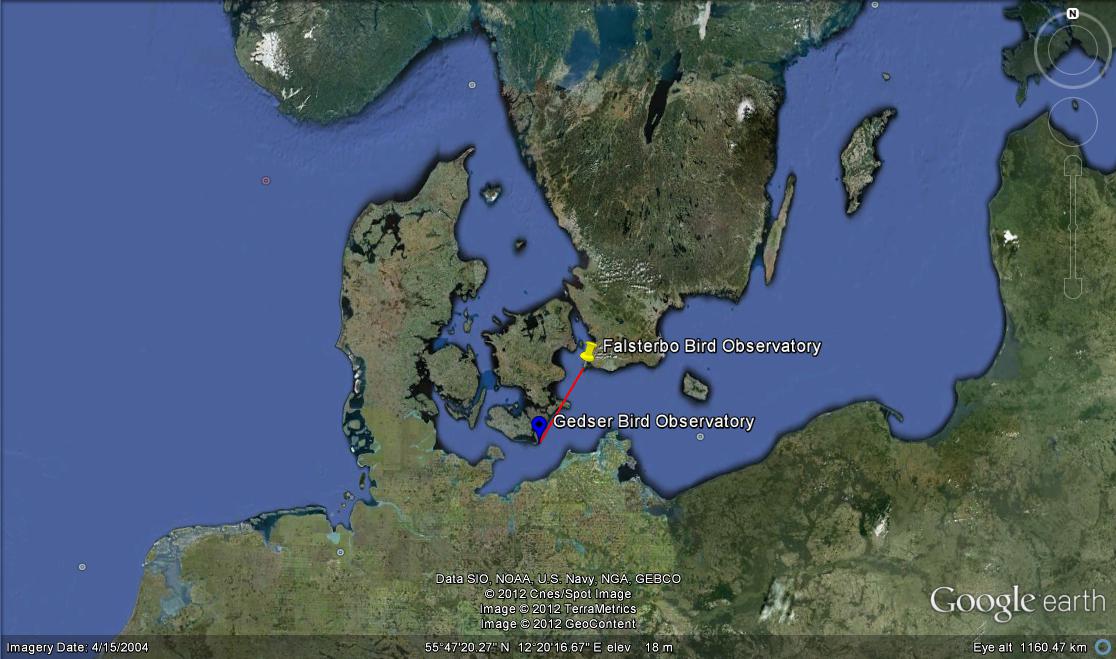
I  also received a batch of Blue Tit recoveries from Gedser where I had controlled some Swedish ringed birds back in October. It turns out all 7 of them were from Falsterbo and had each travelled 106Km in times ranging between 12 and 24 days; mean being 17.14 days. All were 1st year birds and 6 of the 7 were sexed as females, (might sound obvious, but )the last was sexed as a male; sometimes birds are left unsexed. These birds were sexed based on plumage and measurements combined and if there was any uncertainty I would have left them unsexed.

Blue Tit movements between Falsterbo, Sweden and Gedser bird obs, Denmark.
All of these Blue Tit were recovered on October 19th or before and this correlates nicely with the peak passage of Blue Tits over Falsterbo October 2nd, if the birds were on average to take 17 days. Interestingly not all of these birds moved at the same speed as of the three birds ringed on 25th September at Falsterbo, two birds were the fastest recoveries; 12 and 13 days and the last was the slowest (24 days).

As you can see above, it's really easy to get out and read rings on some birds. If you do happen to notice any birds with rings on whilst out and about please report them to www.ring.ac and remember to always check any dead birds for rings. 


Chiffchaff picture - Troels Eske Ortvad